 Hosting guides · United States · El Tri
Hosting a World Cup watch party for a Mexican-American crew
Mexico's three Group A matches, kid-friendly kickoff windows, the food, the music, and the bilingual room dynamics that make a Mexican-American watch party land.
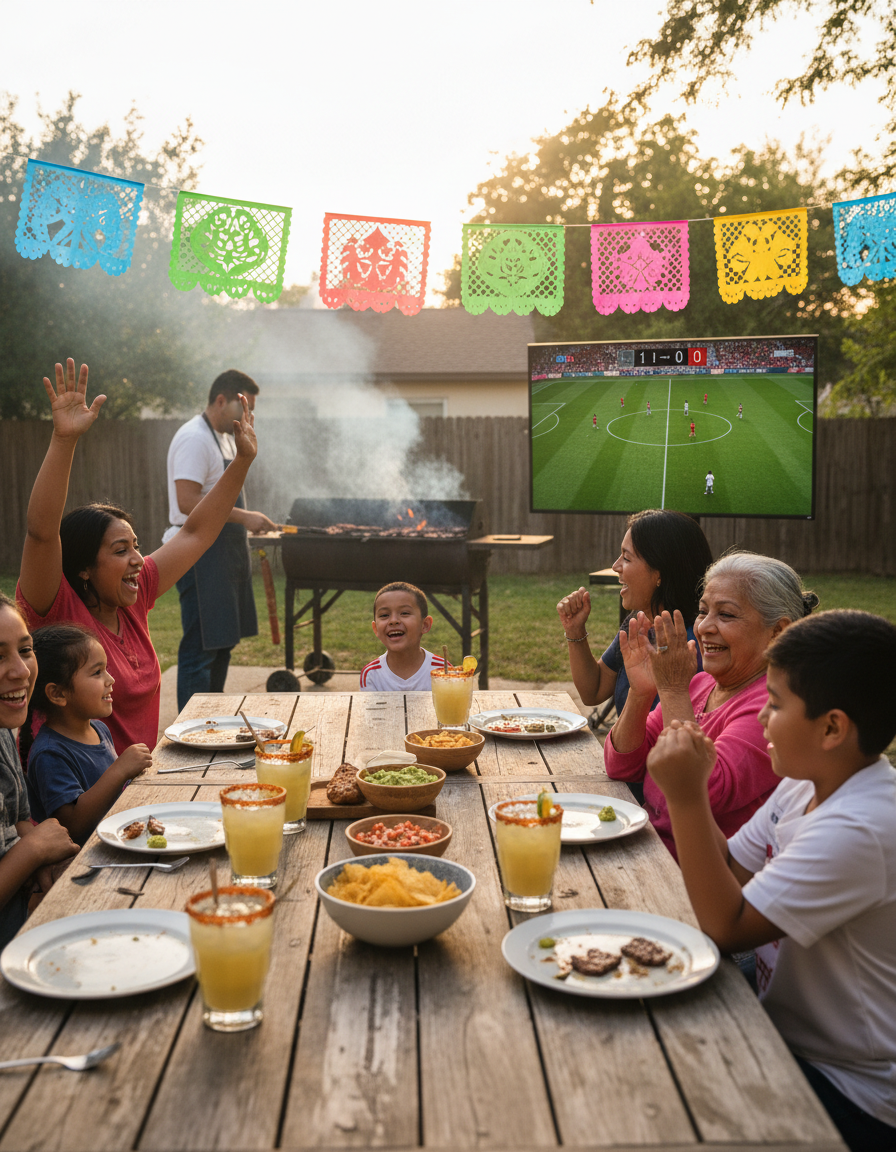
A Mexican-American watch party isn’t the same beast as a generic soccer party at someone’s apartment. The room has abuelas. The room has cousins who flew in. The room has a five-year-old in a Chicharito jersey holding a mini Mexican flag, and that five-year-old is the point of the whole thing. The broadcast is in Spanish. The grill is going outside. A pot of beans is simmering on the stove since 9 a.m.
This is the hosting guide for that room. Mexico’s three Group A matches, kickoff windows you can plan around, the food and music traditions that anchor the party, and the small mistakes outsider hosts make even when they’re trying to do it right.
Set the room before kickoff Spin up your Mexico watch party in 60 seconds → Host your eventTL;DR. Mexico plays South Africa on June 11 (afternoon), Korea Republic on June 18, and Czechia on June 24 (both evenings). Run Telemundo. Carne asada and micheladas for the grown-ups, agua fresca for the kids. Banda or cumbia on low between the action. The afternoon opener is a family event — the evening matches are a different vibe but still kid-permitting on the West Coast. Don’t theme it.
Mexico’s Group A schedule, in kitchen-planning terms
Three matches. Three different times of day. Three different parties.
-
Mexico vs South Africa, Thursday June 11, 3 p.m. ET (2 p.m. CT, 12 p.m. PT) at Estadio Azteca. This is the tournament opener. Azteca becomes the only stadium to host three different World Cups. For a Mexican-American crew, this match is the family event of the group stage. Afternoon kickoff, kids out of school for summer, abuelos can stay through the whole match without it running past their bedtime.
-
Mexico vs Korea Republic, Thursday June 18, 9 p.m. ET (8 p.m. CT, 6 p.m. PT) at Estadio Akron, Zapopan. Evening kickoff. Weeknight. On the West Coast it’s a 6 p.m. start, basically dinner. Central time it’s 8 p.m., so kids can do a half-bedtime. Eastern time at 9 p.m. is the tough one for the youngest cousins.
-
Mexico vs Czechia, Wednesday June 24, 9 p.m. ET (8 p.m. CT, 6 p.m. PT) at Estadio Azteca. Same kickoff slot as the Korea match. A weeknight again. By matchday three you’ll know whether Mexico needs a result to advance, which changes the room’s nerves.
If you’re hosting all three, the opener is the abuelo-and-kids matinee. The other two skew older crowd, later night. Build different menus for each.
The food, written respectfully
A few things to say up front. There’s no single Mexican-American food tradition. What’s on the table depends on where the family’s from in Mexico (Sinaloa vs Jalisco vs Puebla cooks different food), how many generations in the US, what the abuela actually makes well. This section is about the shapes of the food, not recipes. If you’re not Mexican-American and you’re hosting, the food should come from people who are: a Mexican-owned caterer, an abuela who’s offered, a tía who runs catering on the side, the panadería on the corner.
Carne asada is the anchor for any of these matches. It’s not just a meal, it’s a social form. The word describes both the food (grilled, marinated skirt or flank steak, sliced thin for tacos) and the event (a family gathering that lasts half the day). Pati’s Mexican Table on PBS dedicated an episode to “Carne Asada with La Familia” for exactly this reason. It’s the Sunday tradition that became the watch-party default. For the June 11 afternoon match the carne asada starts going on the grill mid-morning. For the evening matches it’s a dinner. Either way, don’t be the host who’s still flipping arrachera during the anthem.
Micheladas for the adults. The cerveza preparada (beer over ice in a salt-and-Tajín-rimmed glass with lime, often Clamato or tomato juice, hot sauce, Worcestershire) is the matchday drink across most of the Mexican-American community. Big US beer producers started bottling cervezas preparadas in the 2010s in response to demand from this exact crowd. You don’t need to mix every michelada to order. Set up a station: ice, salted glasses with Tajín, lime wedges, Modelo or Pacífico, Clamato, Valentina or Salsa Huichol. Adults walk up and build their own at half-time.
Agua fresca for the kids and the non-drinkers. Horchata, jamaica, tamarindo, sandía — pick two, make them in pitchers, keep them on the table all match. The abuelas drink agua fresca. The kids drink agua fresca. The pregnant cousin drinks agua fresca. The driver drinks agua fresca. This is the drink that does the heaviest lifting in the room and nobody talks about it.
Salsas across the heat spectrum. Three minimum. A salsa verde that’s basically not spicy (kids and abuelos who don’t want heat anymore). A red salsa that hits medium. A salsa de chile de árbol or habanero for the cousin who claims everything is too mild. Put them in separate bowls with separate spoons, not one giant bowl that someone double-dips. Tortilla chips next to them, not on top of them.
What I’m not going to do here: write recipes. Recipe content for Mexican food belongs to Mexican-American food writers like Pati Jinich, Esteban Castillo, Bricia Lopez, and the Familia Kitchen network. Send your crew to them. Build your menu around what your abuela or your caterer makes well, not a Google search.
Music between the action
The TV is the centerpiece, but the room has dead air before kickoff, at half-time, after the final whistle. Background music on low does the work. Three genres carry it:
Banda for the grill side of the party. Big brass, tuba bass line, originally from Sinaloa. If the host or any cousin is from Sinaloa, this is already playing. For everyone else, banda is the matchday default in much of the US Mexican community west of Texas.
Norteño is the accordion-and-bajo-sexto sound from the border states. Conjunto norteño with a button accordion can carry an entire afternoon. Norteño covers ranchera, corrido, bolero, and cumbia norteña, a wide enough range that one playlist can run two hours and not feel repetitive.
Cumbia is the dance floor song family. Mexican-flavored cumbia (Los Ángeles Azules, La Sonora Dinamita, Selena’s cumbia catalog) gets the kids and the tías dancing. Save it for the post-match window or play it low pre-match while the food’s coming together.
What’s NOT background music: the broadcast. When the pre-match show starts, the music gets cut and the TV takes over. When the match goes to commercial, you can fade music back in, but be ready to mute it when play resumes. The room follows the screen, not the speakers.
A note on Cielito Lindo. The “Ay ay ay ay” chorus is the unofficial El Tri singalong in US watch parties. It usually happens organically, but if you’re hosting and the goal-celebration moment lands, having the chorus ready to play through the speakers turns a good party into a memorable one.
The broadcast question: Telemundo, FOX, or both
This is the easiest call in the whole hosting guide and it’s the one outsider hosts blow most often.
Run Telemundo. Telemundo is broadcasting 700 hours of World Cup coverage in Spanish from June 11 through July 19, the most extensive Spanish-language presentation of any tournament in US broadcast history, with all 104 matches live on Telemundo and Universo. Andrés Cantor and the Telemundo crew have been calling Mexico for decades. Every two-screen viewer in the Mexican-American community defaults to Telemundo audio for an El Tri match. FOX gets used at neutral bars and English-only crowds.
Peacock streams every match in Spanish too (Premium and Premium Plus subscribers), and the Telemundo app makes the opener and USA vs Paraguay free on Peacock Select. So if your antenna or cable doesn’t give you a clean Telemundo signal, Peacock is the backup.
The mistake outsiders make is defaulting to FOX because “everyone speaks English in this room.” Even bilingual rooms — especially bilingual rooms — want the Spanish broadcast for El Tri. The chants, the anthems, the goal call all live in Spanish. Don’t strip that out trying to be accommodating.
If a few English-only friends are in the room and they want the call in English, FOX on a phone or tablet next to them is the move. The TV is Telemundo.
El Tri in your city Find or list every Mexico watch party near you → Open the team pageThe multigenerational room — abuelas to kids in the same space
The thing that makes a Mexican-American watch party different from most US sports rooms is the age range. A college sports bar has 22-to-35-year-olds. An EPL pub has 30-to-50-year-olds. A Mexico watch party at someone’s house has a four-month-old asleep on tía’s shoulder, a seven-year-old running around in face paint, a 14-year-old on a phone in the corner, parents in their 30s and 40s, abuelos in their 60s and 70s. Sometimes a bisabuela.
Three things this changes:
Seating. The abuelos get the best seats, near the TV, with backs supported. Set this up before they arrive, not after. Pulling a recliner across the room during the first half is bad. The kids sit on the floor or eat at a side table.
Volume. Sports-bar volume — pin-the-needle loud — is wrong for this room. The TV is loud enough that abuela can hear the anthem and the goal call. Not so loud that the baby wakes up. Roughly 60% of the way to the room being silent.
Bedtimes. The afternoon June 11 match is built for kids. The evening matches are not. If you’re hosting an evening Mexico match in Eastern time, plan for kids to fade by the 70th minute and have a quiet kid-room set up (a guest room with a TV, blankets, the same match on lower volume) so parents don’t have to leave at 90 minutes to drive a sleeping seven-year-old home.
Bilingual etiquette without overthinking it
Mixed bilingual rooms are the default for Mexican-American watch parties, not the exception. A few small things go a long way:
- Don’t translate jokes that don’t translate. Spanish humor about a referee decision lands in Spanish. Trying to render it in English usually kills it. Let the joke run.
- Anthem-time is anthem-time. When the Mexican national anthem plays, the room goes quiet and most of the crowd sings. Don’t talk over it. Don’t translate it. Don’t lower the volume.
- Code-switching is normal, don’t comment on it. The bilingual cousin moving between English and Spanish mid-sentence is fluent in both, not “switching.” Don’t make it a thing.
- The kids are the bridge. Second- and third-generation kids often understand more Spanish than they speak. They translate up and down the family. Let them.
The opinion
Here’s where I stand: Mexico kickoffs are family events first, soccer events second. The match is the reason for the gathering but the gathering doesn’t need the match to mean something. If Mexico goes down 2-0 at half-time, the afternoon doesn’t end. The carne asada keeps going, the music comes back up, the cousins keep playing in the yard. A USMNT loss empties the room. A Mexico loss does not. Plan the party for the gathering, not for the result. You’ll throw a better one.
What goes wrong (in order of frequency)
Hosting it like an English-language sports party. FOX on the TV, no carne asada, Bud Light in the cooler, music off. Reads as missing the entire point. Run Telemundo. Get the food right. Cumbia between commercials.
Themed décor. Sombrero piñatas, fake mustaches, “fiesta” banners. Don’t. The watch party doesn’t need a theme. It needs a screen, food, the broadcast, the people. Decorate with one Mexican flag and the green-white-red jerseys people wear, that’s it.
Trying to seat everybody. You can’t. The kids run around. The teenagers stand. The abuelos get chairs. The dads cluster around the grill. Stop counting seats and start counting screens — one main TV, one in a kid room if you have evening matches, maybe one outside for the people at the parrilla.
Cooking the carne asada during kickoff. The grill is a 90-minute commitment. Whoever’s on the grill is going to miss the first half if you start it at kickoff. Either start two hours early and hold the meat warm, or assign the parrilla to someone who genuinely doesn’t mind missing the half (the cousin who likes cooking more than soccer — every family has one).
Telemundo not pre-tested. Don’t be the host who can’t find Telemundo at 2:45 p.m. on opener day. Channel up Telemundo the day before. Confirm it’s not blacked out, not behind a Spanish-language tier you forgot to subscribe to, not buffering on Peacock because your wifi is overloaded. Have the backup ready before guests arrive.
Address-on-Instagram problem. Don’t post the house address publicly. For a private home watch party, share the address only with people who’ve RSVPed. Pitch Party private links handle this automatically. Drop the link in the family group chat and the address unlocks after RSVP. Random cousins-of-cousins don’t show up unannounced.
Where Pitch Party fits
For a Mexican-American family watch party, the share problem is real. The group chat has 40 people in it. Some are coming, some aren’t. Half don’t reply. Three relatives screenshot the address and forward it to their friends. By Saturday you have no idea how much carne to buy.
Drop a Pitch Party private link in the chat and the address only unlocks after RSVP. You see the count live. The day-of reminder fires automatically in both English and Spanish if you set it up that way. Headcount is solved before you preheat the grill.
If you want a public watch party (bigger room, supporters from around the neighborhood) list it as public on Pitch Party. El Tri matches are the highest-search matchdays in US Mexican-American markets, so a public listing tends to fill itself in 48 hours.
Read next:
- Mexico supporters in the United States — where El Tri actually lives
- Mexico vs South Africa preview
- How to host a watch party people actually show up to
Sources:
- Yahoo Sports — 2026 FIFA World Cup daily schedule (https://sports.yahoo.com/soccer/article/2026-fifa-world-cup-daily-schedule-every-match-date-kickoff-time-and-venue-for-all-48-teams-234515087.html)
- NBCUniversal — Telemundo’s 2026 FIFA World Cup Spanish-language presentation (https://www.nbcuniversal.com/article/telemundo-unveils-most-extensive-spanish-language-fifa-world-cuptm-presentation-broadcast-television)
- NBCUniversal — Peacock streaming World Cup 2026 in Spanish (https://www.nbcuniversal.com/article/nbcuniversals-peacock-ultimate-fan-destination-telemundos-exclusive-fifa-world-cup-2026tm-coverage)
- Texas Standard — What to expect at a carne asada (https://texasstandard.org/stories/carne-asada-barbecue-cookout-dishes-what-to-expect-texas/)
- PBS — Pati’s Mexican Table, “Carne Asada with La Familia” (https://www.pbs.org/video/carne-asada-with-la-familia-t1ZJcZ/)
- Familia Kitchen — Carne asada tacos for Mexican summer parties (https://familiakitchen.com/carne-asada-tacos-easy-essential-for-mexican-summer-parties/)
- Wikipedia — Michelada (https://en.wikipedia.org/wiki/Michelada)
- Wikipedia — Norteño music (https://en.wikipedia.org/wiki/Norte%C3%B1o_(music))
- Mexico News Daily — Mariachi, banda, and norteño differences (https://mexiconewsdaily.com/culture/musical-showdown-whats-the-difference-between-mariachi-banda-and-norteno/)
- FIFA — 2026 match schedule (https://www.fifa.com/en/tournaments/mens/worldcup/canadamexicousa2026/articles/match-schedule-fixtures-results-teams-stadiums)
Frequently asked
Quick answers
- What kickoff times are Mexico's three Group A matches in 2026?
- Mexico vs South Africa is Thursday June 11 at 3 p.m. ET (2 p.m. CT, 12 p.m. PT) at Estadio Azteca. Mexico vs Korea Republic is Thursday June 18 at 9 p.m. ET (8 p.m. CT, 6 p.m. PT) at Estadio Akron in Zapopan. Mexico vs Czechia is Wednesday June 24 at 9 p.m. ET (8 p.m. CT, 6 p.m. PT) back at Azteca. Two evening matches and one mid-afternoon opener — plan the menu around the time of day.
- Should I run the Telemundo broadcast or the FOX broadcast for a Mexican-American watch party?
- Telemundo. Telemundo is broadcasting 700 hours of World Cup coverage in Spanish, every Mexico match, with Andrés Cantor calling games. For a Mexican-American crew, English-language audio on an El Tri match reads wrong in the room. If part of the group prefers English, run Telemundo on the main TV and put FOX on a phone or laptop for that pocket of the room.
- What food works for a multi-generational El Tri watch party?
- Carne asada is the default for evening matches — it's a Sunday tradition that doubles as a watch party. Add micheladas for the adults, agua frescas for the kids and abuelas, and three salsas across the heat spectrum so nobody gets left out. Don't try to cook the carne asada during the match; grill ahead and keep it warm, or assign the parrilla to someone who's not married to the result on the screen.
- How do you handle a bilingual crew when half the room speaks mostly English and half speaks mostly Spanish?
- Three moves. Run Spanish on the broadcast (cultural default), make sure both languages get airtime in the room (don't let English-only conversations dominate the kitchen while Spanish-only conversations get isolated on the patio), and let the kids switch between both — they're often the bridge. Don't translate anthems or chants. If someone wants the words, they'll ask.
- Are Mexico's evening kickoffs (Korea, Czechia) too late for kids?
- Depends on the time zone. A 9 p.m. ET kickoff is 6 p.m. PT — totally workable on the West Coast for school-age kids. Same kickoff is 8 p.m. CT in Texas, manageable for older kids on a summer night, harder for toddlers. The afternoon opener (3 p.m. ET, 12 p.m. PT) is the most kid-friendly of the three Mexico matches across every US time zone.
Pitch Party · the app
Spin up your watch party.
Pitch Party handles the room.
Pick a venue, set kickoff, share the link. Pitch Party runs the RSVPs and reminders so the room fills the way you planned for it.